
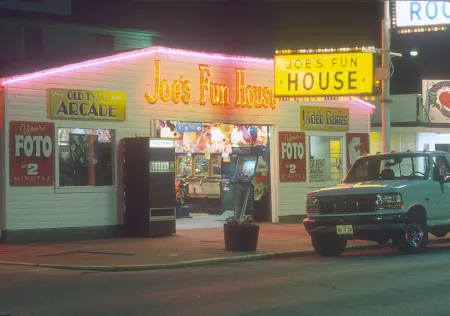
Joe’s Fun House was an arcade located in front of the former Cleveland Hotel at the corner of Lake Road and Spencer Avenue from 1956 to 1994, when Alice Campbell Miller sold the business and building to Andrus. The building still stands, as does the Cleveland Hotel.
A smaller, square structure to the west of what was the Fun House was there when Joe and Alice Miller purchased the Cleveland Hotel. It soon became the 19 Cent Hamburger stand, operated by Mary Jane Miller and her half-sister, Nancy Kaferle.
A classic arcade game from the 1950s, the Fun House was built by Joe Miller in 1957, who, with his wife, Alice (Campbell), had purchased the Cleveland Hotel from the Regner family in 1953.
Alice grew up in Painesville, one of 12 youngsters in the family. Her mother was determined that her girls would become entertainers, and she aggressively promoted the eight daughters to any event or venue that would have them. Alice sang with two of her sisters in the Cleveland area before she married.
“My mother was a very beautiful woman in her younger days,” says Mary Jane Robinson of Geneva, Alice’s younger daughter.
“But our grandmother said that when you got married, you got booted out of the act,” adds Tom Miller, Alice’s son. “There were eight girls, so there was always a replacement to come along.”
Alice’s first husband died when he was 32, leaving her with one daughter, Nancy Robinson. She met Joe, and the couple married, forging a union that her children called “sparky” at best and ended in divorce in 1981. Alice ended up with the real estate at GOTL.
Joe’s father had left the family while he was a young man, so he was accustomed to the hardships Alice had known. Joe learned about forestry during the two years he spent in the Civilian Conservation Corps. A young man typically was limited to one year in the CCC, but the situation with Joe’s siblings and mother was so dire that a letter written to the president requesting that he be allowed to stay in an extra year (most of the young man’s earnings were sent to the family) got him a second year.
He served in the Navy aboard a submarine chaser during World War II and helped build the foundation for the Rayon plant in Lake County. Although he had only a 10th-grade education, Joe was a journeyman electrician but was not admitted to the union ranks in Cleveland, which thwarted his earning potential.
A lifelong learner, he was always reading and attending seminars on starting and running a business, especially in food and hospitality. His step-children, Tom and Mary Jane, say Joe and their mother came close to becoming one of the first McDonald’s franchises in the United States after they met Kroc at a seminar.
Instead, the couple purchased Chapman’s Restaurant on Route 20 west, Geneva (the building still stands as home to a Hispanic congregation). Chapman’s was a seven-day-a-week diner, restaurant, and bar that was extremely popular with both locals and the motorists who drove Route 20, before Interstate 90 was opened.
The workload was exhausting to Alice, who rarely got more than three or four hours of sleep a day. In 1953, the couple was given the opportunity to trade their successful restaurant for the aging Cleveland Hotel and Restaurant at Geneva on the Lake. It seemed a reasonable trade since Alice and the children would have to work only three months out of the year rather than 12. Further, they knew Interstate 90 would be built and that the traffic so vital to Chapman’s success would be siphoned off onto the super highway.
Running the Cleveland proved to be even more work, as the family now had not just a restaurant but hotel rooms and cottages to look after. Further, there was the 19-cent Hamburger Stand next to the Cleveland that Nancy and Mary Jane had to run.
Three years into running the hotel, Joe decided that an arcade would provide a stronger revenue stream with less work. He designed and raised the building himself and opened it the following year. By that time, the family was so broke they had to take out a loan to get the coins that would circulate through the arcade that summer, Tom says.
The arcade opened in 1957 and featured many popular games from the 1940s, such as Pokerino, shuffle alley, a downsized bowling game, a shooting gallery, and rotary merchandise. There were three pool tables, and it was a 100-foot walk, or more correctly, “run,” back to the tables from the counter. Patrons loved to steal the 8 ball, and Joe rigged up a system between the pool tables and the supervisor’s counter that alerted the employee or owner that the game had ended and they needed to make sure all the balls were accounted for.
Joe’s Fun House used a coupon system to pay out prizes. Players accumulated coupons as they won, and the coupons could be redeemed for the merchandise that covered two of the walls in Joe’s Fun House.
“We had blankets, art glass, china figurines, ceramic things,” Tom recalls.
Postcards of ladies in naughty nighties and celebrity portraits could be purchased from a machine for 2 cents each. If a minor “accidentally” got a pack of the nudie cards from a rotary machine, he was required to turn it in for 50 cents at the counter.
Any machine in the business that involved a game of chance, and there were 40 such machines, required a federal license. And the license was $250 per machine, per year.
“We probably had one of the biggest tax bills down there,” Tom says. “You had to make enough money in May and June to pay your taxes in July.”
To increase revenues, Joe also owned and operated games at the Penny Arcade east of the Fun House. The attractions there included the love meter, funny mirrors, and foot vibrators. For a nickel, the customer could give their feet a vibrational treat. They called it the Playkade. It was located in a chartreuse building at the corner of Golf and Lake Road, and no longer stands.
Tom says they purchased Playkade from George Konold. It cost $22,500, and they sold it for $5,000.
Joe was very handy with his mechanical and electrical skills, and he spent most mornings repairing games and other devices. “If he didn’t have the part, he’d make it,” Tom says.
Joe was the first family member to go to bed, usually by midnight. But Alice and the children would stay up past closing, 2:30 a.m.
“You were never done,” Mary Jane says. “And we were never off duty as children growing up.”
“We didn’t have time to walk the Lake,” Tom adds.
Because the arcades had large, open doors, the counters had to be dusted several times a day. Patrons from nearby bars had no reservations about urinating on the building or even inside. As part of the arcade’s maintenance team, Tom has scrubbed down his share of these incidents.
Nevertheless, thanks to the family’s hard work, every one of the children received a college education and advanced degrees. The children are grateful for what growing up and working at the lake gave them.
“We met some wonderful people down there, and we were friends with them all our lives. That is the thing that holds (the business owners at GOTL) together down there, the people who come in year after year.”
Address
5498 Lake Rd. E.
Geneva-on-the-Lake, OH 44041